
Houston Homeowners: Should You Sell Your House or Turn It Into a Rental?
Houston Homeowners: Should You Sell Your House or Turn It Into a Rental?
Imagine you're ready to move into your next home, but your current house hasn't sold at the price you expected.
You have two options.
You could adjust your asking price, sell the property and move on with your plans. Or you could keep the house, rent it to a tenant and collect monthly income while holding on to the property.
At first, the second option sounds appealing.
Why sell a home when someone else could pay you rent to live in it? And if the housing market improves later, couldn't you sell the property then?
For some Houston homeowners, that strategy makes sense. For others, it can turn into an expensive commitment they never intended to make.
The decision to sell or rent isn't just about whether you can find a tenant. It's about whether keeping the property makes financial sense for your situation.
That question is becoming increasingly relevant in Houston. A recent Houston Chronicle report identified Houston as a leading market for so-called accidental landlords – homeowners who originally planned to sell but decided to rent instead. The report highlighted how property taxes, maintenance, insurance and growing rental competition can leave owners with little profit, even when they successfully find tenants.
So, if you're a Houston homeowner considering your next move, how do you decide whether selling your house or turning it into a rental is the smarter choice?
Why More Houston Homeowners Are Considering Renting Instead of Selling
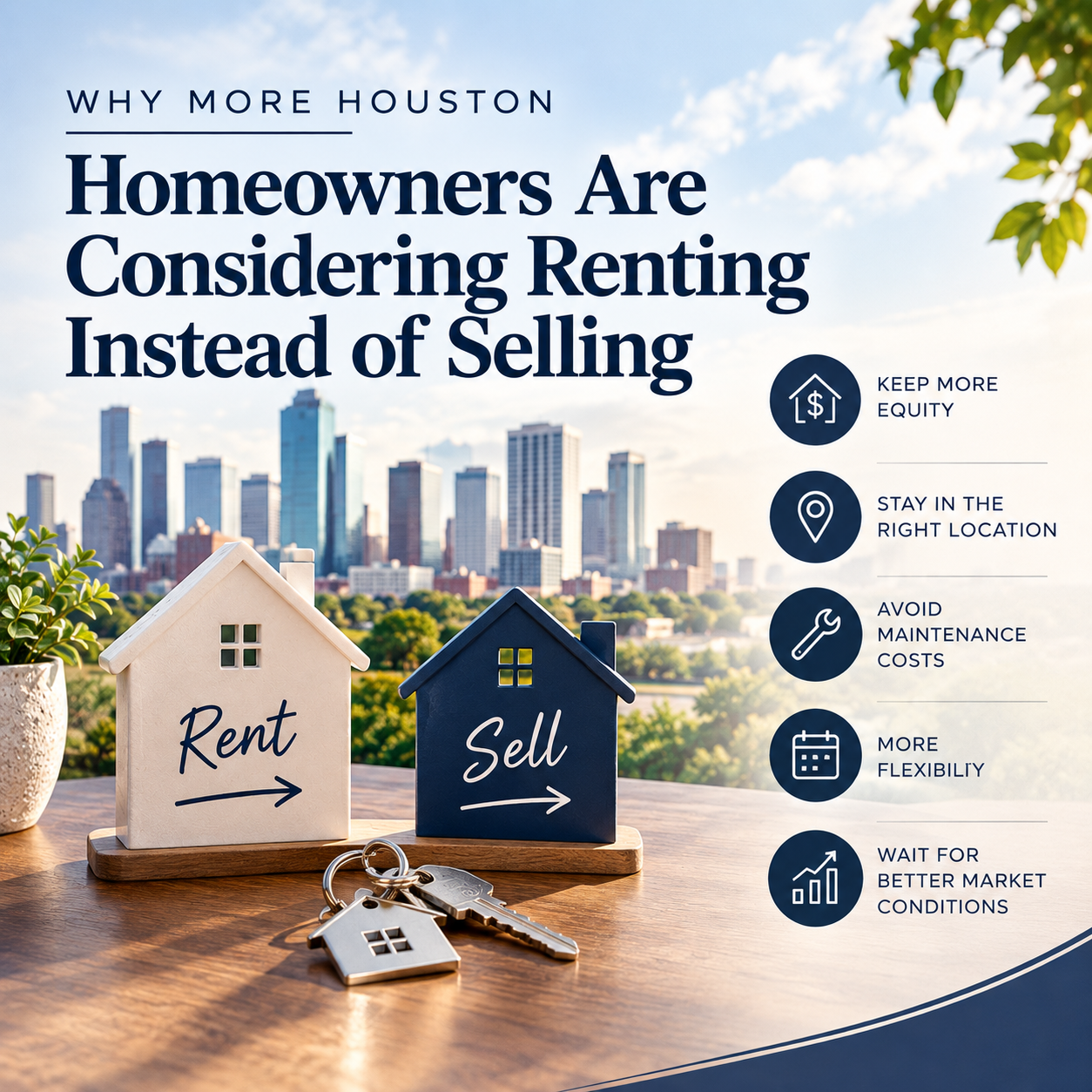
Selling a home doesn't always happen on the timeline an owner expects.
You may have already purchased another property. You may be relocating for work. You may need to move closer to family. Or you may simply feel that the offers you're receiving don't reflect what your home is worth.
When a property takes longer to sell, renting can begin to look like an attractive alternative.
Instead of accepting an offer below your expectations, you could lease the property, receive rental income and potentially benefit from future appreciation.
But there's an important difference between choosing to become a landlord as part of a long-term investment strategy and becoming one because your home hasn't sold.
A rental property should work as an investment, not simply as a way to postpone a difficult selling decision.
Before you choose either path, it's worth understanding what each one could mean for your finances, responsibilities and future plans.
Option One: Selling Your Houston Home and Moving Forward
Selling offers one major advantage: clarity.
Once the transaction closes, you can access the proceeds remaining after the mortgage payoff and selling expenses. You can use that money toward your next home, pay down other debts, invest elsewhere or build a financial cushion.
You also eliminate the ongoing responsibilities associated with owning a property you no longer live in.
That means no tenant management, no coordinating routine repairs from another location and no worrying about whether the property will sit vacant between leases.
For homeowners who need money from their current property to finance their next move, selling may be the more practical option.
It can also make sense when the property's rental income would not comfortably cover its expenses or when you don't want to take on the responsibilities of being a landlord.
However, selling comes with its own considerations.
You need to account for the mortgage payoff, agent compensation if applicable, closing costs, potential repair requests and any other expenses associated with the transaction. Your final proceeds may be considerably different from the property's sale price.
That's why it's important to estimate your likely net proceeds before deciding whether to accept an offer or explore renting.
Option Two: Turning Your Home Into a Rental Property
Renting allows you to keep ownership of the property while collecting income from a tenant.
Depending on your circumstances, it may help you retain an asset, build long-term equity and preserve the possibility of moving back into the home later.
For example, a homeowner relocating temporarily for work may prefer to rent the property rather than sell it and purchase another home upon returning to Houston.
Similarly, an owner with a manageable mortgage balance and a property that generates positive cash flow may decide that keeping the home fits their long-term investment plans.
But rental income is not the same as profit.
A tenant's monthly payment may cover the mortgage and still leave the owner with little money after taxes, insurance, maintenance, vacancy and management expenses.
And even if the home is paid off, ownership still comes with costs.
The important number isn't how much rent you collect. It's how much you keep after paying the expenses of owning and operating the property.
The Houston Rental Market May Not Be as Easy as You Expect

Some homeowners assume that renting will be straightforward because people always need places to live.
But demand for housing doesn't guarantee that a particular property will rent quickly or at the price an owner wants.
Houston's rental market has continued to offer renters more choices. According to the Houston Association of REALTORS®' July 2026 rental report, single-family homes averaged $2,419 in monthly lease price, while active rental listings stood at 9,832. Homes took an average of 37 days to lease, compared with 34 days a year earlier.
Those are market-wide figures, not a forecast for any individual property. Your home's potential rent will depend on its location, condition, size, features and competing rentals.
The challenge is that your property may be competing against other homeowners, professional landlords and newly built rental homes.
If several similar properties are available nearby, prospective tenants have choices. You may need to adjust your rent, improve the property's presentation or wait longer for a qualified tenant.
During that time, your expenses continue.
Before deciding to rent, research what comparable homes are actually leasing for, not simply what similar owners are asking.
The Hidden Costs That Can Change the Decision
This is where many homeowners discover that renting is more complicated than they expected.
Property Taxes
Property taxes can represent a significant portion of the cost of owning a Houston-area home.
If the property is your current principal residence, you may qualify for a homestead exemption. Converting the home to a rental generally means it no longer qualifies for the residence homestead exemption.
That can affect your tax bill, so check the property's current exemptions, taxable value and projected taxes after the change with the appropriate appraisal district or a qualified tax professional.
Don't assume that the current tax bill will remain unchanged after you move out.
Insurance
Your existing homeowners insurance may not provide the coverage you need once tenants occupy the property.
The Texas Department of Insurance advises homeowners to speak with their insurer about rental-property coverage and whether landlord insurance is appropriate.
Before advertising the property, obtain a quote based on the intended rental arrangement. Make sure you understand the coverage, exclusions and liability protection.
Maintenance and Repairs
Every home requires maintenance, but a rental property introduces another level of responsibility.
A water heater can fail. An air-conditioning system can stop working during a Houston summer. A roof can develop a leak. Appliances may need replacement between tenants.
These costs don't necessarily occur every month, which makes them easy to underestimate.
A sensible rental analysis should include a maintenance reserve rather than assuming that every dollar remaining after the mortgage payment is profit.
Vacancy and Property Management
What happens if the tenant moves out and you need several weeks to find another one?
What if the next tenant expects repairs before moving in?
What if you live outside Houston and cannot easily coordinate maintenance?
You may decide to manage the property yourself or hire a property manager. Either approach has a cost, whether it's measured in money, time or both.
These expenses need to be included in your calculations before you decide whether the rental is financially worthwhile.
Don't Overlook the Tax Implications of Renting
Taxes are another reason to think carefully before converting your primary residence into a rental.
When you sell a qualifying primary residence, you may be eligible for a federal capital gains exclusion of up to $250,000 for an eligible individual or $500,000 for eligible married taxpayers filing jointly, subject to IRS ownership, use and other requirements.
The general rule requires qualifying ownership and use of the property as your principal residence for at least two of the five years before the sale. Renting the home for an extended period after moving out can affect whether you still qualify.
Rental ownership can also introduce income-tax reporting, deductible expenses, depreciation and potential depreciation recapture when the property is sold.
The rules depend on your circumstances, and the tax consequences can be significant.
Before converting your home to a rental, ask a qualified tax professional how the decision could affect your future sale and tax position.
Don't assume that you can rent the property for several years and receive exactly the same tax treatment you would have received by selling now.
When Renting May Make More Sense
Renting can be worth considering when the property supports a clear long-term plan.
Perhaps you're relocating temporarily and expect to return to Houston. Maybe you have a low mortgage payment, sufficient reserves and a realistic rental rate that comfortably covers your projected expenses.
You may also be willing to hold the property for several years and accept the responsibilities that come with being a landlord.
In these situations, renting can offer flexibility and the possibility of building wealth over time.
But the plan should still work under less favorable conditions.
What happens if the property sits vacant for a month? What if the air-conditioning system needs replacing? What if insurance premiums or property taxes rise? Can you cover those costs without putting your own finances under pressure?
A rental strategy is stronger when you can answer those questions before a problem occurs.
When Selling May Make More Sense
Selling deserves serious consideration when the property no longer fits your financial goals or lifestyle.
If you need the proceeds for your next home, carrying two mortgages may create unnecessary financial pressure.
If the likely rent won't cover your ownership expenses, the property may require you to contribute money every month.
If you don't want to manage tenants or coordinate repairs, the responsibilities may outweigh the potential benefits.
And if you're considering renting only because you don't want to accept a realistic offer, it's worth asking whether holding the property will genuinely improve your position.
Houston's current market conditions do not guarantee that waiting another year will produce a better sale price. Nor does renting guarantee that you will recover the difference through rental income or future appreciation.
Sometimes, selling at a price supported by current market conditions can give you greater financial flexibility than holding a property that doesn't generate enough income.
Could You Market the Home for Sale and Rent?
For some homeowners, the decision may not need to be immediate.
You might explore both options while evaluating the property's market value and realistic rental potential.
That can help you understand what buyers are willing to pay and what tenants might realistically pay to live there.
However, managing both strategies requires care. Before signing a lease, consider how a tenant's occupancy and lease terms could affect a future sale, including the buyer pool and timing. Review any applicable mortgage, HOA, insurance and lease requirements as well.
If you're considering this approach, discuss the timing and marketing strategy with your real estate professional before committing to a tenant.
The Right Decision Starts With Three Questions
Before deciding whether to sell or rent, answer three questions honestly.
First: What would I actually receive if I sold today?
Estimate the likely sale price, mortgage payoff and transaction costs to understand your net proceeds.
Second: What would I actually keep if I rented the property?
Estimate realistic rent, mortgage payments, taxes, insurance, maintenance, vacancy and management expenses. Don't leave out irregular costs simply because they aren't due every month.
Third: What do I want this property to do for my future?
Are you trying to free up cash, relocate without complications, preserve a property for a future return to Houston or build a long-term rental portfolio?
Your answer matters because the highest possible sale price and the highest possible rental income aren't necessarily the same as the best decision for your circumstances.
Houston Homeowners Need a Strategy, Not Just a Backup Plan
The choice between selling and renting isn't always straightforward.
Selling can provide liquidity and a cleaner financial transition. Renting can preserve ownership and potentially create income over time.
Both have advantages. Both carry risks.
The key is to evaluate the actual numbers, understand your responsibilities and consider how the decision fits into your long-term plans.
Don't become a landlord simply because your home hasn't sold yet. Become one only if the property, the finances and your goals support that decision.
Should You Sell Your Houston Home or Keep It as a Rental?
Before you make a decision, take a closer look at your property's current market value, potential rental income, expected ownership expenses and long-term possibilities.
The Gonzalez Legacy Group can help you understand how your home compares with competing properties in the Greater Houston market and explore your selling options based on current conditions.
If you're weighing a sale against keeping your home as a rental, connect with The Gonzalez Legacy Group to discuss your property and plan your next move with greater clarity.
Categories
Recent Posts









Team Lead, Trusted Real Estate Advisor License ID: 0542785
+1(832) 766-0195 | elisa@gonzalezlegacygroup.com